Gi or no-gi, that is the question
Introduction
Lately, the traditional kimono, or gi, has become less popular in the grappling world.
Still, it's worth recognizing the role the gi plays as a teaching tool in our sport.
In this post I'll lay out a few reasons why I think your grappling journey should include plenty of training in "pyjamas."
Of course, if you're a professional athlete competing in ADCC, you should focus your training on no-gi. You might also want to consider how much friction-reducing prep you use on your skin (balm, lotion, oil), and the same goes for training lapel-based techniques if you're competing at black belt in IBJJF.
The no-gi spectrum
Before I get into the benefits of gi training, a quick word on what no-gi actually covers.
There are plenty of options: shorts, rashguards, wrestling gear, and various accessories like knee pads and wrestling shoes.
On top of that come the friction-related decisions mentioned above, like shaving your limbs or using lotion.
So even within the no-gi world, you're dealing with quite a few choices when it comes to what you wear.
I hope the arguments below help you decide what to wear for grappling.
Choosing between gi and no-gi
Arguments for training in pyjamas
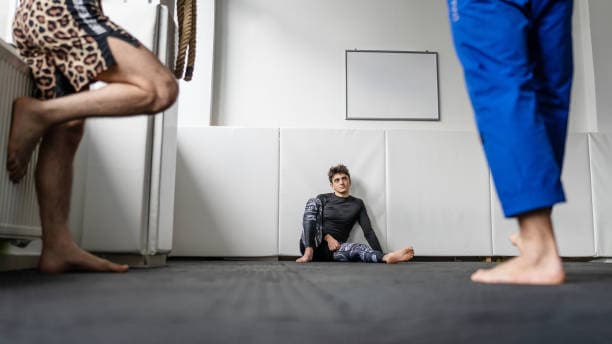
If the same rules applied to gi and no-gi competition, let's be honest, fighting and training in a gi is harder. You need to know the same movements, grips and strategy as in no-gi, but on top of that you need the knowledge to deal with the gi itself. Notice that gi specialists tend to do well in no-gi competition, but rarely the other way around. If the rulesets for gi and no-gi differ, that skill gap might be less obvious, but I'm convinced it's always there. The same goes for good wrestlers — they'll have an edge in both gi and no-gi, every time.
No-gi training is slicker than gi, which makes it less safe and more prone to injury (fingers being the exception, since those wear down more from gi training). The mat gets wet fast, and without cotton clothing to help dry it, that doesn't improve. Movement is faster, and slip-related accidents happen more often.
Kimonos aren't as visually appealing as thermal base layers. No-gi's popularity may, at least in part, be tied to evolutionary social behaviour — no-gi favours an athletic build. Pyjamas, on the other hand, hide the body, which helps some people get past their shyness. As a teacher, I sometimes take my gi top off during class, since it can hide the grip details of certain techniques.
Training in a gi lets you train under no-gi rules, but the reverse isn't possible. It all comes down to what you agree with your training partners. You could agree not to "grab clothing," the same way you might decide on a no-leg-grabbing session (after an injury, for example) or a no-choking session (if you were recently knocked out — remember it's not a great idea to get knocked out repeatedly in a short span of time).
A few more differences
In no-gi, a strong grip matters a lot, but it's hard to train because most grips get slipped out of easily. Training in a gi makes gripping easier, which gives you more room to build grip strength and technique.
The same goes for hips. When you train in a gi, both hands often end up "stuck" in the lapels while trying to choke, so you can't post on your hands — your hips take over the job of stabilizing your body.
No-gi teaches a more offensive game, which matters a lot. But early on it makes more sense to build your defensive skills first, since that translates into your offensive game later, or at least lowers the fear of moving from offense back into a defensive cycle. Chokes are a lot easier with a gi (with the exception of chokes that don't use any fabric at all).
The belt shows your skill level, which — depending on the club — can either help or get in the way of your overall progress. Some schools care so much about belt colour that they've introduced belt-coloured rashguards.
Athletic people will have the edge in no-gi training. Putting on a kimono adds friction and evens out some physical differences. Slowing the fight down also gives you extra time to think through strategy and technique.
Worth remembering: these people spent over 10 years training in a gi — Eddie Bravo, Khabib Nurmagomedov, Lachlan Giles, Craig Jones, Mikey Musumeci, Gordon Ryan, Marcelo Garcia, Roger Gracie... Nicky Rod might be the only one who never trained in pyjamas... maybe.
At the end of the day, what matters most is showing up to class, whatever you decide to wear. From my own experience, I recommend training in a gi while focusing on your no-gi game, and of course communication with your training partners as the baseline for everything.
Comparison
| GI | NO-GI |
|---|---|
| Harder | Easier |
| Safer | Less safe |
| Less slippery | More slippery |
| Less sexy | More sexy |
| Natural fabrics | Synthetic fabrics |
| More laundry | Less laundry |
| Higher upfront clothing cost | Lower upfront clothing cost |
| More realistic self-defense | Less realistic self-defense |
| Improves grip strength | Makes gripping harder |
| Easier hip movement development | Harder hip movement development |
| Harder to escape | Easier to escape |
| Easier to attack | Harder to attack |
| Belt shows skill level | No skill indication |
| Not just for the strong | Easier for the athletic |
| Slower | Faster |
| Favors lapel chokes | Favors chokes without fabric |
Should I wear a rashguard under my gi?
That's up to you. So far I haven't found evidence that rashguards are actually better at preventing skin rashes than a cotton kimono. Given how much plastic goes into rashguards, there might be something to that. Either way, your training partners might find fabric more pleasant to rub against than bare skin.


